Is AEO the new SEO, or just new noise?
How AEO and GEO differ from SEO, how AI search actually works, what the independent data says, and which tactics really move the needle.
If you have opened anything about marketing in the last six months, you have met the scary new letters: AEO. Its sister GEO is usually right next to it, and someone on top is selling a bootcamp called "get into ChatGPT answers in 7 days." It sounds like a new religion you suddenly have to convert to.
Let us sort this out honestly: what it is, how it differs from plain old SEO, how it actually works, and (most importantly) what is backed by data versus what is just being sold to you. I went through the research and split it into two piles: independent studies, and studies funded by the companies that sell "AI visibility" tools. The two piles often disagree, and that gap is half the story.
AEO, GEO, SEO: what do these letters even mean?
Three acronyms, all ending in "O" for optimization. Here is the whole difference in simple words.
- SEO (Search Engine Optimization) - optimizing for the list of blue links. Goal: rank higher so a person clicks.
- AEO (Answer Engine Optimization) - optimizing to be the direct answer a search engine or voice assistant shows on top, with no visit to your site.
- GEO (Generative Engine Optimization) - optimizing so that ChatGPT, Perplexity, Gemini or Google's AI answers cite you when they assemble a reply.
And one honest note so you do not build false hope. In practice AEO and GEO are often used as synonyms, and half of the "new discipline" is good old SEO under a new sauce. That is not me being cynical, it is what the least biased people in the field say.
A new marketing discipline? Or not
I like to show contested topics as they are, not as one "correct" opinion. So:
- Google, in its official guide, states plainly that optimizing for generative search is still SEO.
- Trade press (Digiday) puts it more bluntly: AEO, GEO and the rest mostly mean the same thing, with no standard definitions.
- And who shouts loudest that "this is a brand new discipline, enroll now"? Usually the people selling tools and courses for that exact discipline.
My take: treat AEO and GEO not as a new profession but as an extension of SEO. Same foundation, a new layer on top. If someone sells you a "revolution that cancels everything you knew," keep a hand on your wallet.
How AI search actually works
Here is the mechanism that everything else depends on. A generative engine builds its answer in two steps:
- Retrieval. First a normal search layer pulls candidates: pages and chunks of text relevant to the query. Often chunks, not whole pages.
- Generation. Then a language model assembles a coherent answer from those chunks and decides who to cite.
This is where the difference from old SEO comes from, and it is simple:
- The retrieval layer is still a search layer, so your SEO foundation gets you into the candidate pool. Without it you are not even in the room.
- But the choice of who to cite is made by generation, and it looks at the properties of the text itself, not at your backlinks or domain age. That is where AEO and GEO add something new.
- The engine pulls chunks, so leading with the answer at the top of a section genuinely helps you land in a citation.
In short: the AI does not "read the whole internet." It is handed a few paragraphs and decides whose to quote. Your job is to make your paragraph easy to quote.
What raises your odds of being cited (a study)
The one academic paper the whole GEO industry leans on is from Princeton, Georgia Tech and the Allen Institute for AI, arXiv 2311.09735 (KDD 2024). The authors tested nine methods and measured how each changed visibility inside the engine's answer. The short version of what worked:
| Method | Effect |
|---|---|
| Expert quotations in the text | best result |
| Concrete statistics and numbers | strong gain |
| Citing sources | strong gain, especially for weaker sites |
| Plain, readable language | moderate gain |
| Keyword stuffing (the classic SEO move) | negative, it hurts |
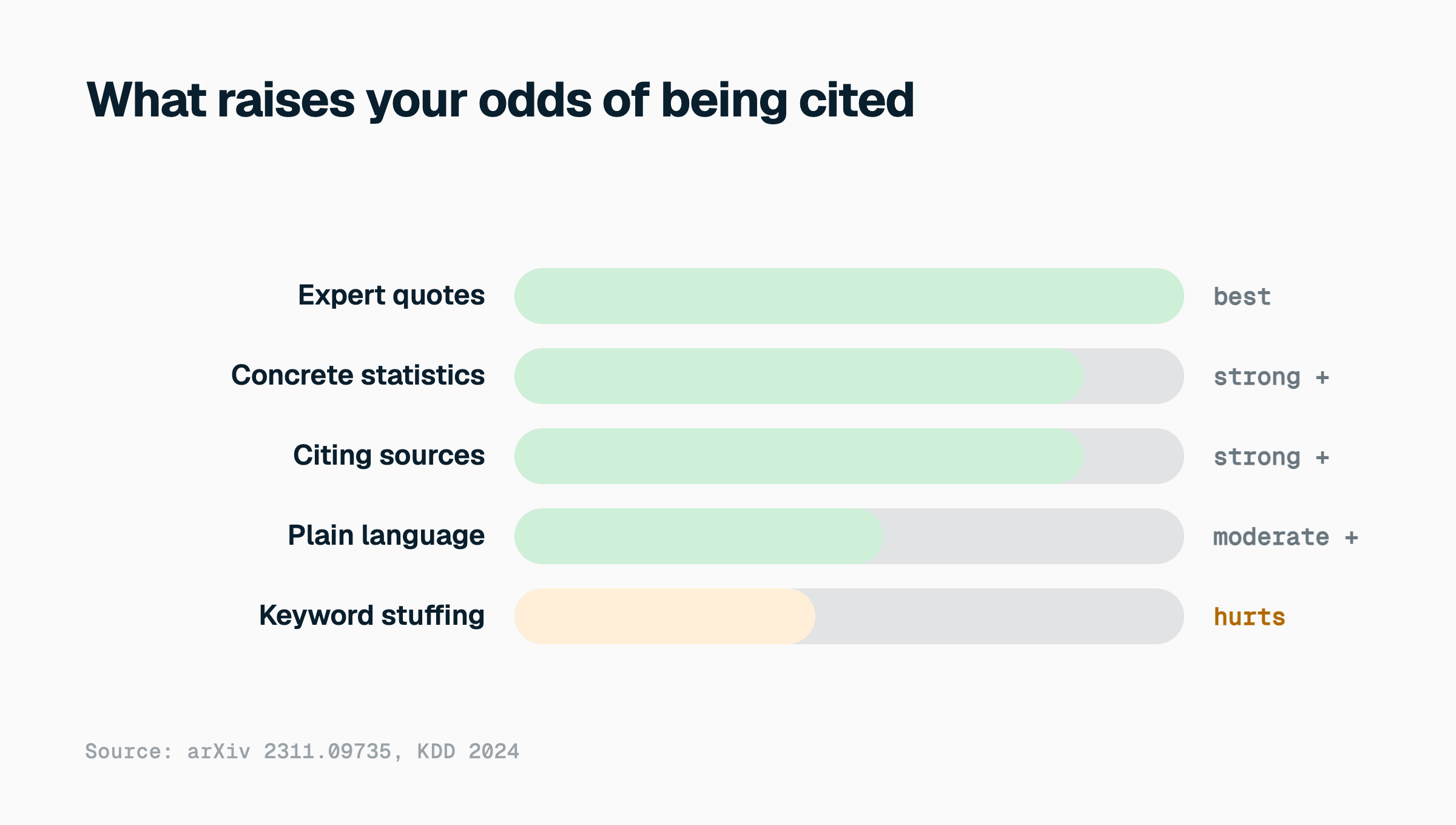
The authors' main conclusion: engines value not only the content but the presentation. Numbers, quotes and cited sources are exactly what "easy to quote" looks like.
Now the honest caveat that course sellers tend to swallow. The headline "up to 40% visibility" was measured mostly on a simulator (top-5 Google results fed to an older model that then wrote the answer). The one live engine they tested, Perplexity, showed a more modest effect. So the entire "research-backed GEO" industry rests on one 2023 paper run on a simulation. That does not mean the tactics are fake, it means trust the direction, not the exact percentages.
What the data says about money and traffic
This is the sobering part. I lean on independent sources, because vendor studies (from the people selling the tools) systematically paint a rosier picture than reality.
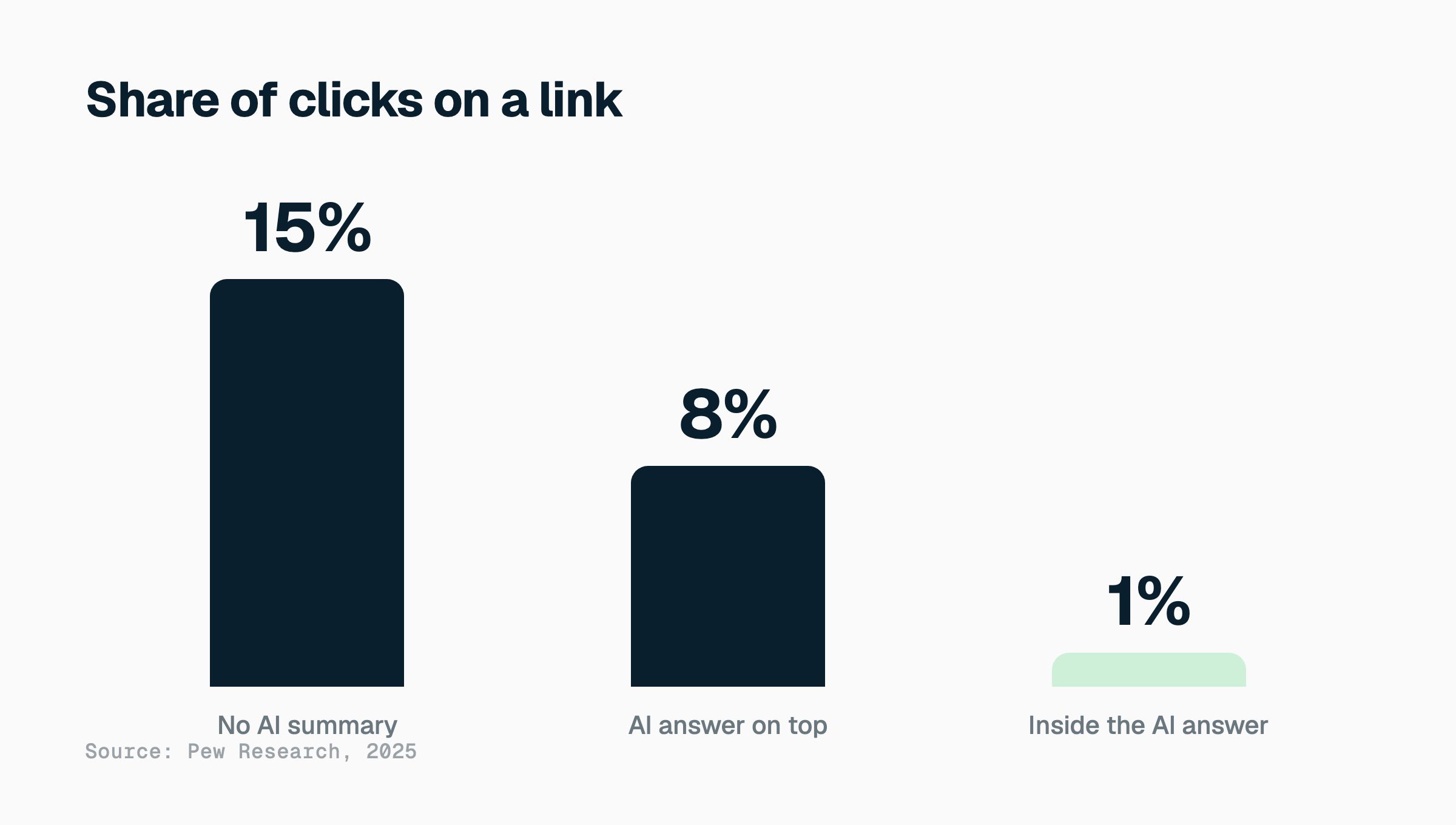
Clicks are dropping, that is a fact. The independent Pew study, on real user behavior: when an AI summary sits on top, people click a link in 8% of visits versus 15% without it, almost half as often. They click a link inside the AI summary just 1% of the time. So the AI answer mostly kills the click.
The share of no-click searches is growing. Per SparkToro, in 2026 fewer than a third of Google searches send a click to a website. The click-through rate of the top position when an AI answer is present has dropped by roughly 58% according to Ahrefs.
Does AI traffic convert better? Here it really pays to ask who funded the study. Tool vendors love numbers like "AI visitors buy far more eagerly." But the largest independent study (a peer-reviewed paper across 973 online stores) says the opposite: ChatGPT referrals convert worse than regular search, email and affiliate. Same reality, opposite conclusions, and the difference is exactly who paid.
A small skill I give to anyone reading these reports: ask "percent of WHAT." "Reddit is cited 40% of the time" and "Reddit is 2% of citations" are often the same reality, just divided by different denominators.
Where search engines like to pull citations from
Another durable fact, from Profound data on hundreds of millions of citations: engines have different "personalities."
- ChatGPT pulls mostly from Wikipedia.
- Perplexity and Google's AI answers love Reddit.
- The engines' source sets barely overlap (around 11% in common).
And it is all very volatile. ChatGPT's share of Reddit citations fell from about 60% to 10% in five weeks. So any pretty "here is who the AI cites" report has a short shelf life. Do not build a strategy on a single snapshot.
What to actually do, sorted by evidence
Now the practical part, laid out honestly: what is proven and what is being sold.
Works (do it):
- Put substance in the text: concrete numbers, statistics, expert quotes, cited sources. This is the best-supported lever.
- Grow brand mentions, not just links. Per Semrush, brand mentions correlate with AI citations noticeably more than backlinks do.
- Be where engines pull sources from: Reddit, niche reviews and roundups, Wikipedia. It works, but mind the volatility.
- Answer first. Lead with the answer at the top of a section, details after. Easier for the human and for the chunk-pulling engine.
Hype (do not waste effort):
- Schema markup as a citation generator. The loudest pitch on the thinnest evidence. Experiments show models read markup as plain text, with little effect on citations.
- llms.txt for AI search. A nice idea, but Google does not support it and AI search barely requests it. The file is genuinely useful to developer tools, not to marketing.
- Keyword stuffing. It actively hurts, as the study above shows.
How to measure it
GEO tools (Profound, Peec, Otterly, the suites from Semrush and Ahrefs) measure share of answer: how often and in what position your brand shows up in AI answers versus competitors. The method is the same for all of them: run a set of prompts across the engines and parse the answers.
One honest caveat: since the signal is volatile, one prompt is not enough. Use a large set (a hundred or more prompts per topic), or you will be measuring noise instead of yourself. And do not be surprised that different tools give different numbers: they use different prompt sets.
What a business owner should actually do
Short version:
- Do not buy the "revolution." AEO and GEO are a layer on top of SEO, not a replacement for it.
- Do the boring but effective things: expert text with numbers and quotes, presence where engines source from. Skip schema and llms.txt.
- Track share of answer rather than traffic, but remember the numbers wobble.
- And keep a sober frame: this is not a gold mine right now, it is defending your presence in a channel where people increasingly get an answer without reaching your site.
FAQ
Are AEO and GEO the same thing?
In practice they are often used as synonyms, and there are no standard definitions. Roughly: AEO is about being the direct answer (including voice and snippets), GEO is about being cited inside generative AI answers. But if someone builds a whole separate profession on the difference between these letters, that is usually marketing more than substance.
Should I forget about SEO now?
No. The search layer has not gone anywhere, and it is what gets you into the citation pool. SEO is the entrance, GEO is about whether you are easy to quote. One does not work without the other.
Will schema markup get me into AI answers?
The evidence for that is thin, and the pitch is loud. Experiments show models read markup as plain text. Do it for regular search if you need to, but do not expect a miracle in AI answers.
Should I pay for an AI visibility tool?
If AI channels are already a meaningful source for you, yes, to see your share of answer and the trend. Just use a large prompt set and do not treat the number as absolute truth: the signal is volatile and tools will disagree.
Does AI traffic sell well?
The data argues with itself here. Tool vendors say "great," the largest independent study across 973 stores says "worse than regular search." The truth likely depends on your niche, so do not budget for a gold rush in advance.
If you would rather not guess, and actually see where your company already shows up in AI answers and what to do about it, write to me on Telegram or leave a request. Tell me what you do, and I will tell you honestly where the real lever is and where you are just being sold a pretty acronym.
Drop the article into your AI and adapt it to your own task.
ChatGPT or Claude will open with a ready prompt about this piece. Take it from there.

Hi, I'm Anna.
In business since 2011, and for the last few years I build AI automation. I founded moremotions.ru, co-own Heritage, and put together bots and integrations for small business. Based in Tbilisi, working remotely with the whole world.

Want to automate something in your business?
Tell me what you're sick of doing by hand. 30 minutes for a brief, then a concrete offer or an honest no if it's not my kind of task.